
Signet Ring Engraving UK 2026: Designs, Cost, Process
The most important rule of signet ring engraving is that the design must be carved as a mirror image.

This is because for two thousand years a signet ring was used to press into hot wax, and the wax impression is the right way around when the ring’s engraving is reversed. A signet engraved correctly will read “left to right” in the wax even though the metal itself shows the letters or crest backwards. Modern signet rings that are worn purely as jewellery sometimes ignore this rule and engrave the design the normal way, which is fine if you don’t intend to seal anything with wax. But the wrong choice here changes the entire piece. A correctly engraved signet ring is still functional 500 years later. A “modern” engraved signet ring is purely decoration.
That detail alone tells you why signet ring engraving is the most researched decision in men’s jewellery. You’re not just picking a font. You’re deciding whether the ring is a working object or a decorative one, whether it’s a piece your grandson can use the same way you do, or a piece that only works as accessory.
This is the full UK guide to engraving choices, processes, costs, and design rules in 2026.
I run Monrich, a UK men’s jewellery brand offering free laser engraving on signet rings. Disclosure up front.
Why engrave a signet ring?

A plain signet ring is a piece of jewellery. An engraved signet ring is a personal artefact.
The functional reason (historical): signet rings were used to seal documents in melted wax. The engraving was the signature. The deeper and more distinctive the engraving, the more uniquely identifiable the seal.
The modern reason (sentiment): signet rings carry the wearer’s personal mark constantly. Initials, a date, coordinates of a meaningful place, a family symbol. Every time you look at your hand, the mark is there.
The heirloom reason: an engraved signet becomes a family object. Passed from grandfather to son to grandson, the engravings tell a multi-generational story.
For most modern men: the engraving is what makes the signet ring “yours” rather than “a ring”.
Design options
Initials (most common)
1-3 letters, in serif or sans-serif font. The most traditional and timeless choice.
Common formats: - Single initial: “K” (first letter of first name) - Two initials: “KC” (first + last) - Three initials: “KMC” (first + middle + last) - Reversed initials (intaglio style): designed to seal wax with correct-reading impression
Monogram
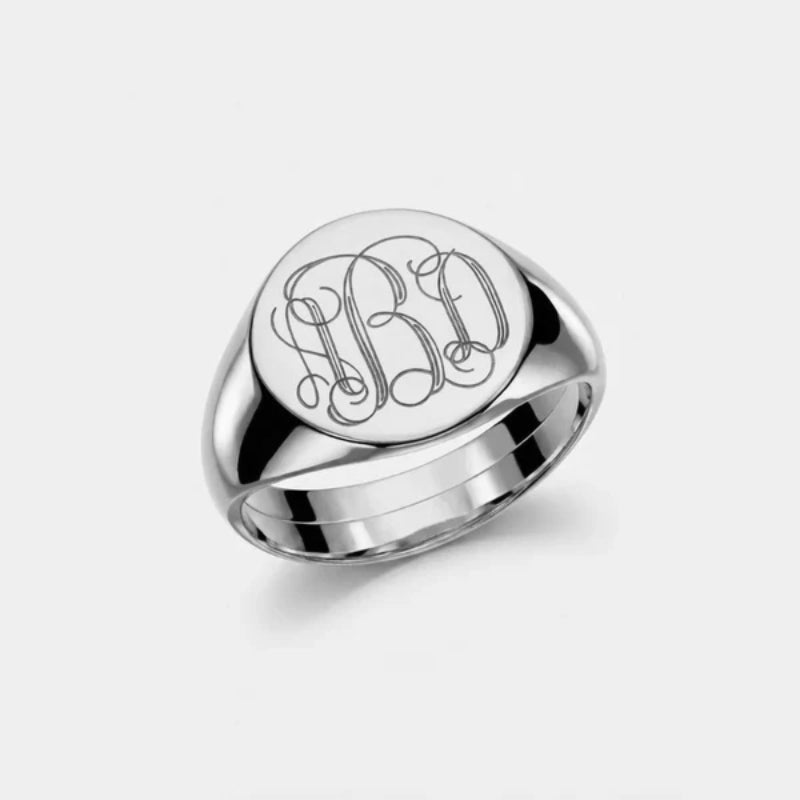
Multiple initials intertwined into a single decorative design. More elaborate than simple letters. Often custom-designed.
Common monogram styles: - Classic interlocked: letters overlap each other - Stacked: letters arranged vertically - Heraldic: letters within a shield or decorative frame
Cost is higher than plain initials because monogram design is custom-drawn.
Family crest / coat of arms
For those with documented family heraldry. The College of Arms in London is the authority on English family arms.
Process: 1. Verify family entitlement to a crest (via the College of Arms or family records) 2. Have the crest formally drawn for engraving 3. Engraved by hand by a master engraver (laser cannot do the detail of a proper crest)
Cost: £300-1500+ for genuine hand-engraved family crest.
Symbol
A single meaningful symbol replacing letters. Increasingly popular in modern signet rings.
Common symbols: - Religious: cross, Star of David, crescent - Astrological: zodiac sign - Memorial: anchor (sailor), wings (pilot), specific symbol of a passed family member - Personal: animal, plant, geographic landmark
Date
Birthday, anniversary, milestone date. Often in Roman numerals for elegance (X.IV.MMXX for 10 April 2020).
Coordinates
GPS coordinates of a meaningful place. Format varies (degrees / minutes / seconds, or decimal). The trend is 2023-2026.
Phrase / quote
A short phrase that means something to the wearer. “Memento mori”, “Never not”, “Family first”. Best for short phrases (3 words max) that fit on a signet face.
No engraving
A polished signet face without engraving is a valid modern choice. Reads as minimal / intentional.
This is the most important technical decision.
Hand engraving vs laser engraving

This is the most important technical decision.
Hand engraving
Done by a master engraver with hand tools (gravers, burins). The engraver cuts directly into the metal, creating sharp, deep lines with character.
Pros: - Each engraving is unique (the hand of the engraver leaves character) - Deeper, longer-lasting marks (can last centuries on solid gold) - Higher artistic value - The standard for crests, coats of arms, heirloom pieces
Cons: - More expensive (£100-1000+ per piece) - Slower (typically days or weeks of work) - Requires finding a master engraver (rare skill)
Laser engraving
Done by a CNC laser machine. The laser cuts patterns at high precision based on a digital design.
Pros: - Cheaper (£10-50 typically, included free with some brands like Monrich) - Faster (minutes per piece) - High precision (sharp, consistent letters) - Replicable (same design across multiple pieces)
Cons: - More mechanical look (less character than hand engraving) - Shallower (typically less deep than hand engraving) - Cannot easily do elaborate crests or true intaglio (sinking) designs
Which to choose
- For mass-market signet rings (£40-200): laser engraving. The price tier doesn’t support hand engraving and laser does an excellent job for letters / dates.
- For sterling silver signets (£150-400): laser is the standard. Hand engraving available for £150-300 extra at master engravers.
- For solid gold heirloom signets (£500+): hand engraving is the tradition. The piece itself is investment-grade, so the engraving should match the quality.
- For family crests / coats of arms: hand engraving only. Laser cannot do the detail and authenticity of a proper crest.
Engraving costs UK 2026
The cost gap reflects the labour and skill difference between machine and hand work.
| Type | Cost range |
|---|---|
| Laser engraving (initials, dates, simple symbols) | £10-50 (free at Monrich) |
| Pantograph engraving (machine-driven, mid-quality) | £40-100 |
| Hand engraving (initials, simple monogram) | £150-400 |
| Hand engraving (custom monogram with design work) | £300-800 |
| Hand engraving (full family crest) | £500-2000+ |
| Heritage / heirloom-grade hand engraving on solid gold | £1000-3500+ |
The cost gap reflects the labour and skill difference between machine and hand work.
Choosing your design

Think about permanence
The engraving will be on the ring for decades. Choose something that will still mean something to you in 20 years:
- Initials: timeless
- Family crest: timeless
- Significant date: timeless if the date is genuinely significant
- Current phrase / trend: risky (trends fade)
- Tribute to a relationship: depends on the relationship (be careful with romantic engravings if the relationship is recent)
Consider readability
The signet face is small (10-15mm). Detailed designs can become indistinct at this size. For best readability:
- 1-3 letters / characters max per line
- Bold designs preferred over thin
- Avoid overly intricate scripts that lose detail at small size
Consider style
The engraving design should match your overall aesthetic:
- Classic serif initials: traditional English aesthetic
- Sans-serif initials: modern minimal aesthetic
- Family crest: heritage / aristocratic aesthetic
- Coordinates: modern sentimental aesthetic
- Symbol: depends on the symbol’s cultural reading
Process step-by-step
For laser engraving (typical online order)
- Order ring with engraving option selected
- Submit your design (initials, date, symbol selection from menu)
- Brand confirms design via mock-up image (24-48 hours typical)
- Engraving applied (1-2 days)
- Ring ships
Total time: typically 5-10 working days from order to delivery.
For hand engraving (master engraver)
- Consult with engraver (in person or by email)
- Design developed (sketch + revisions)
- Design approved
- Engraver hand-cuts the design (days to weeks of work depending on complexity)
- Final inspection and shipping
Total time: typically 4-12 weeks from consult to delivery.
Total time: typically 5-10 working days from order to delivery.
Where to get a signet ring engraved
As part of a new ring purchase
Most brands offering signet rings include or offer engraving services:
- Monrich: free laser engraving included with all signets. Browse signets.
- Craftd London: free engraving with most signets.
- Cernucci: paid engraving (£10-30 per piece).
- Hatton Labs: paid engraving (sterling pieces). Laser standard, hand engraving available at extra cost.
Adding engraving to existing rings
Take to a local jeweller who offers engraving services. Most UK towns have at least one jeweller with laser engraving equipment. Cost: £20-60 typically.
For hand engraving (master engravers)
- Rebus London: London signet specialist
- Andrew Lamb / Lamb’s Jewels: hand engraving for heirloom pieces
- The College of Arms: family crest research and engraving (London)
- Various Birmingham Jewellery Quarter masters: established UK tradition
Best engraving styles by personality
Classic / traditional
- Serif initials (Times, Garamond style fonts)
- Family crest if applicable
- Hand engraving preferred
Modern minimal
- Sans-serif initials (single letter or two letters)
- Single symbol
- Laser engraving fine
Sentimental
- Coordinates (place that means something)
- Date in Roman numerals
- Phrase that means something
Heritage / aristocratic
- Family crest
- Coat of arms
- Hand engraving essential
Bold / statement
- Larger initials covering most of face
- Bold symbol
- Either laser (modern) or hand (premium)
This is because for two thousand years a signet ring was used to press into hot wax, and the wax impression is the right way around when the ring’s engraving is reversed.
FAQ
How much does signet ring engraving cost in the UK?
Laser engraving: £10-50 (often free with new signet purchase). Hand engraving by master engraver: £150-1000+. Family crest hand engraving: £500-2000+.
Can a signet ring be re-engraved later?
Yes if there’s space. Existing engraving cannot be removed cleanly (it leaves marks), but new engraving can be added to a different part of the face or the band. For heirloom pieces with deep hand engraving, re-cutting is possible by a master engraver.
What should I engrave on my first signet ring?
Most popular: initials (1-3 letters of your name). Most personal: coordinates or date that means something specifically to you. Most heritage: family crest if you have one. Avoid: trendy phrases, romantic gestures from new relationships.
How long does engraving last?
Hand-engraved marks on solid gold: centuries (the gold doesn’t wear and the deep cuts retain definition). Laser engraving on PVD-plated stainless: as long as the plating lasts (12-36 months on quality PVD). Hand engraving on sterling silver: many decades.
Can you laser engrave on solid gold?
Yes, but it’s not the tradition. Solid gold signet rings (£500+) typically warrant hand engraving for the heirloom value and depth of cut. Laser on solid gold is acceptable for modern minimal designs.
Is engraving included with signet ring purchase?
Depends on the brand. Monrich includes free laser engraving. Craftd London includes free engraving. Most premium brands (Hatton Labs, Le Gramme) charge separately for engraving.
Built after wearing the others.
Different by design.
PVD-plated 316L. 1-2 micron thickness declared. 12-month tarnish guarantee in writing. Permanent buy one get one free across the full catalogue.
Browse Monrich → UK shipping 2-4 days / 30-day returns / no customs


