

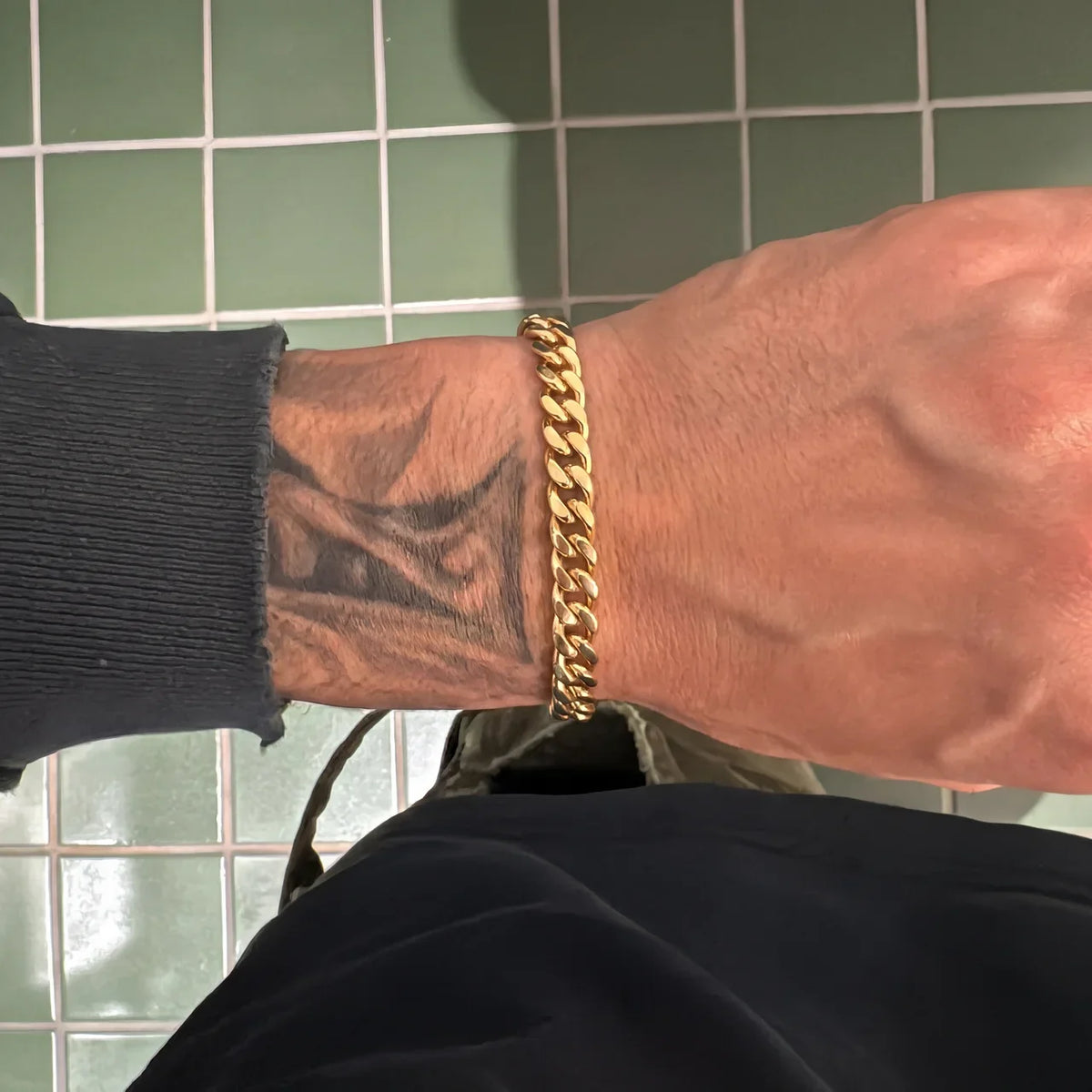
ID Bracelet vs Cuff Bracelet Men UK 2027
The ID bracelet closes with a clasp. The cuff bracelet doesn't close at all.

That single mechanical difference drives almost every other distinction between the two formats. The ID bracelet wraps fully around the wrist with a clasp closure. The cuff sits as a rigid open band that slips over the hand with the gap typically at the back of the wrist.
Both are dominant men’s wrist styles in the UK in 2026, both look great on the right wearer in the right context, but they aren’t interchangeable. Picking the right one depends on what you want from the piece and how it’ll sit on your specific wrist shape.
I run Monrich, a UK men’s jewellery brand with both formats in the catalogue. Disclosure first.
You can see the current men's bracelets line-up for reference as you read.
Quick answer

The ID bracelet is the more versatile pick. It sizes to specific wrist measurement, accommodates engraving on the flat ID plate, works across all occasions, and reads as classic men’s jewellery in 2026.
The cuff is the more distinctive pick. It’s harder to size correctly, reads as deliberate style choice rather than default, and works best in casual to evening contexts (less so in business formal). The aesthetic is stronger but the wearability range is narrower.
If you want one bracelet that works everywhere, ID. If you want a piece that signals intentional style, cuff.
Closure difference
ID bracelet closure: lobster clasp (most common), spring ring, or push-button clasp. The bracelet opens fully for putting on and removing, then closes around the wrist for a fixed fit.
Cuff closure: none. The bracelet is a rigid open band with the gap at the wrist’s back. You slip your hand through the gap to put it on, then slide the cuff into position on the wrist.
The closure difference means: - ID bracelets fit any wrist within the sized range - Cuffs only fit wrists within a 0.5”-1” tolerance of the cuff’s specific internal diameter - ID bracelets adjust over time with weight gain/loss - Cuffs don’t adjust; if your wrist size changes meaningfully, the cuff stops fitting
ID bracelet closure: lobster clasp (most common), spring ring, or push-button clasp. The bracelet opens fully for putting on and removing, then closes around the wrist for a fixed fit.
Weight and feel

ID bracelet weight: typically 20-40g depending on chain weight and ID plate size. The weight is distributed around the full wrist.
Cuff weight: typically 30-60g depending on cuff thickness and width. The weight is concentrated at the rigid band, which means the cuff feels heavier per gram than an ID bracelet.
The feel is also different. ID bracelets move with the wrist, can slide up and down the forearm slightly, and feel like a worn piece. Cuffs sit fixed in position, don’t move with wrist rotation, and feel more like a fitted accessory than a worn piece.
Some men prefer the ID bracelet’s movement. Others prefer the cuff’s fixed feel.
Sizing approaches
ID bracelet sizing: measure your wrist with a soft tape measure, add 0.5-1” for comfort, choose nearest standard size (7”, 7.5”, 8”, 8.5”, 9”). Most ID bracelets include an extender chain for fine adjustment.
Cuff sizing: measure your wrist for both circumference AND width across the wrist (top to bottom). The cuff’s internal diameter must match your wrist’s “across” measurement plus 0.25” for slip-on clearance. Cuffs come in S/M/L typically (small = 5.5” internal diameter, medium = 6.25”, large = 6.75”).
Cuff sizing is harder to get right remotely. ID bracelet sizing is more forgiving and standardised.
ID bracelet engraving: traditionally on the flat top “ID plate” between the two chain sections.
Engraving options

ID bracelet engraving: traditionally on the flat top “ID plate” between the two chain sections. Engraving area is typically 30-50mm × 10-15mm, enough for name, initials, date, coordinates, or short message.
Cuff engraving: typically on the outside surface of the rigid band. Engraving area is larger (50-100mm × 10-20mm depending on cuff width), accommodating longer messages or graphic engraving.
For minimalist engraving (initials, name, date), ID is the natural fit. For longer messages, quotes, or graphic engraving, cuff offers more space.
Occasion fit
ID bracelet works across: - Business formal and casual - Weddings (groom, groomsmen, guest) - Evening dinner - Daily office wear - Weekend casual - Travel - Gym (depending on material)
Cuff works best for: - Weekend casual - Streetwear styling - Evening dinner (depending on cuff aesthetic) - Creative industry office (advertising, fashion, design) - Festival, beach, holiday
Cuff works less well for: - Strict business formal (the visible gap can read as casual) - Conservative office cultures - Strict traditional wedding
ID bracelets have broader wearability range across UK contexts. Cuffs work brilliantly in their context band but don’t cross over to formal as easily.
ID bracelet layering: pairs cleanly with cord bracelets, beaded bracelets, other chain bracelets, and watches on the same wrist or opposite wrist.
Layering compatibility
ID bracelet layering: pairs cleanly with cord bracelets, beaded bracelets, other chain bracelets, and watches on the same wrist or opposite wrist.
Cuff layering: harder to layer with chain bracelets (the rigid cuff and flexible chain don’t sit comfortably together). Pairs well with watches on the same wrist or other cuffs/cord on the opposite wrist.
For multi-bracelet layered looks, ID is the more flexible primary piece. Cuff works best as the focal piece with minimal additional bracelet layering.
What the wrist test reveals
There’s a useful diagnostic for ID vs cuff: put each style on for a single workday and see which one you forget you’re wearing.
An ID bracelet, sized correctly, becomes almost invisible to the wearer within an hour. The chain slides slightly with wrist movement, the ID plate sits flat against the back of the wrist, and the weight is distributed evenly enough that you stop noticing it. The bracelet exists in your peripheral consciousness, not your active attention.
A cuff bracelet, sized correctly, stays present in awareness throughout the day. The rigid band doesn’t move with the wrist, so the contact points stay constant and the wrist registers them. You’re more aware of when it touches your watch, your sleeve, the underside of a table. The cuff exists in active attention.
This isn’t a problem for the cuff. Some wearers prefer the constant tactile reminder, the sense that the piece is “there”. Others find it slightly distracting and prefer the ID bracelet’s quieter presence.
The test reveals something about how you want jewellery to function in your life. If you want pieces that integrate seamlessly into daily wear, the ID bracelet fits better. If you want pieces that maintain physical presence, the cuff fits better.
Worth noting: the difference is most pronounced in the first 1-2 weeks of wearing a new piece. Both styles fade into background awareness over time, but the ID bracelet typically gets there faster.
There’s a useful diagnostic for ID vs cuff: put each style on for a single workday and see which one you forget you’re wearing.
Which to pick
Pick an ID bracelet if you want: - A versatile bracelet that works across all UK contexts - Easy sizing with extender adjustment - A clean classic men’s bracelet aesthetic - A piece for engraving (initials, coordinates, date) - A foundation piece for layering with cord and beaded bracelets
Pick a cuff if you want: - A distinctive statement piece - A piece that doesn’t require clasp opening/closing - A larger engraving area for longer messages - A specifically casual-to-evening aesthetic - A fixed-position feel rather than a moving piece
Browse the Monrich ID bracelet range and the cuff bracelet collection to compare. The ID bracelet men UK guide covers ID format in depth.
FAQs
Can I size a cuff bracelet online?
You can, but it’s harder than sizing an ID bracelet. Measure wrist circumference, wrist width (the side-to-side measurement at the wrist bone), and your hand’s broadest point. The cuff needs to slip over the hand and rest on the wrist with the gap at the back.
Why do cuffs feel heavier than ID bracelets?
The weight in a cuff is concentrated in the rigid band rather than distributed around the wrist as in an ID bracelet. Same total weight feels heavier in a cuff because of how it sits on the wrist.
Which is more durable?
Both formats are durable in the right material. PVD-plated 316L ID bracelets last 3-5 years on plating. Cuffs in the same material last similarly. The clasp on an ID bracelet is a small failure point that doesn’t exist on a cuff. The cuff’s rigid shape can deform if dropped or impacted hard.
Can a cuff bracelet be resized?
Limited resize possible. A jeweller can bend a cuff slightly to tighten or loosen the fit by 0.25-0.5”, but cuffs are designed to be a fixed shape. Significant size change requires a new cuff.
Are cuffs more masculine than ID bracelets?
This is heavily context-dependent. Cuffs read more “bohemian” or “designer” in some markets and more “statement” in others. ID bracelets read more “classic men’s jewellery”. Neither is more masculine in any absolute sense.
Which is better for engraving a long message?
The cuff offers more engraving area (50-100mm vs ID’s 30-50mm typically). For coordinates, a quote, or longer message, cuff is the better-positioned piece. For initials or a name, ID is more conventional.
Built after wearing the others.
Different by design.
PVD-plated 316L. 1-2 micron thickness declared. 12-month tarnish guarantee in writing. Permanent buy one get one free across the full catalogue.
Browse Monrich → UK shipping 2-4 days / 30-day returns / no customs


