
Cuban Chain vs Rope Chain Men UK 2027: Which to Pick
Hold a Cuban chain and a rope chain side by side at the same width and length, and the difference in feel is immediate.

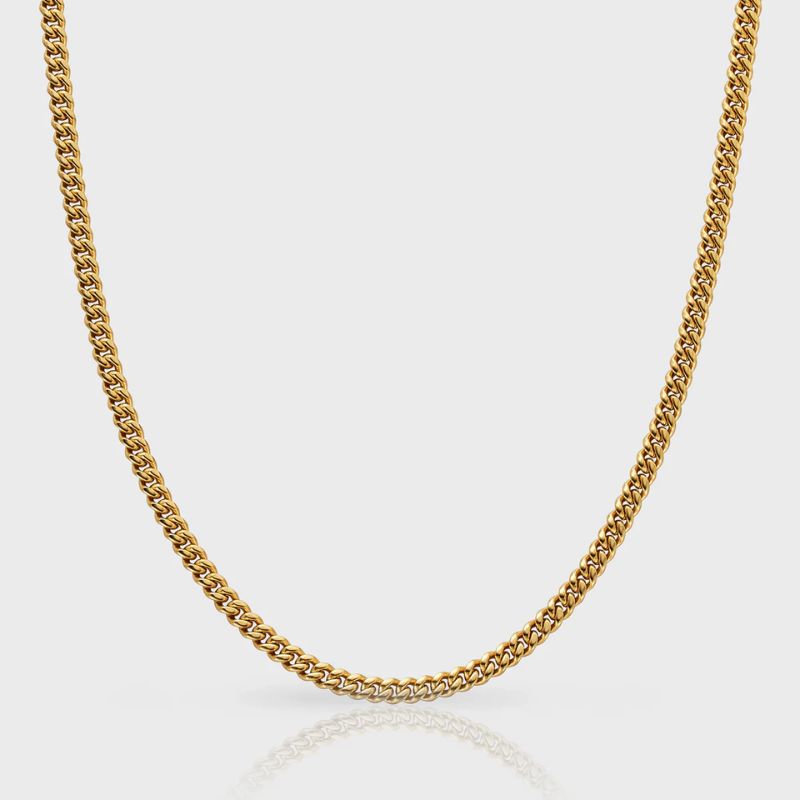
The Cuban chain is dense and flat. The links are interlocking, machine-pressed, and laid out so the chain sits flush against the skin. Pick it up and it has the texture of a single rigid object.
The rope chain is twisted and three-dimensional. The links are angled and spiral around the chain’s axis, so it never sits flush, it always has a slight twist along its length. Pick it up and it feels almost alive in your hand.
That tactile difference is the heart of the Cuban-vs-rope decision, and most men’s jewellery guides skip it entirely. The two chains aren’t variants of the same thing. They produce completely different visual effects, fit different body frames differently, and read differently across contexts.
This is the honest side-by-side for UK men in 2026.
I run Monrich, a UK men’s jewellery brand with both styles in the catalogue. Disclosure up front.
You can see the current men's cuban chains line-up for reference as you read.
Quick answer

The Cuban chain is the more versatile, easier-to-wear pick for most UK men. It works at the office, the gym, weddings, and weekends, and the design has the longest cultural shelf life of any men’s chain style in 2026.
The rope chain is the more distinctive pick. It catches more light, has more visual texture, and reads as a more deliberate style choice. It also reads slightly more dated to some viewers (the rope chain peaked in the 1980s and is in a “second wave” rather than continuous popularity).
If you want one chain that will work anywhere, pick Cuban. If you want a chain that signals intentional style, pick rope.
Visual difference
Side by side, a 4mm Cuban chain and a 4mm rope chain look completely different from across a room. The Cuban appears as a clean horizontal band on the chest. The rope appears as a textured shimmering line that catches and scatters light along its length.
In photography, the Cuban photographs as a solid silhouette. The rope photographs as a sparkling line with visible texture. This is why rope chains were the dominant men’s chain in 1980s music videos, the camera-side sparkle was the visual point.
In daily wear under a shirt collar, both chains look essentially identical (just a strip of metal at the neckline). The difference is fully visible only when worn on bare skin or against contrasting fabric.
At the same width and length, a rope chain weighs roughly 15-25% more than a Cuban chain.
Weight and feel

At the same width and length, a rope chain weighs roughly 15-25% more than a Cuban chain. This is because the rope’s spiral structure uses more metal per linear inch than the Cuban’s flat-link structure.
The weight difference is meaningful for wearer comfort. A 4mm Cuban in 22” weighs roughly 15-20g. A 4mm rope in 22” weighs roughly 18-25g. Over an 8-hour work day, that extra weight is felt at the back of the neck.
For men with sensitive neck skin or who wear a chain through long days, the Cuban’s lower weight-per-cm is the more comfortable spec.
Durability comparison
Both Cuban and rope chains are built from interlocking metal links, so they share the same primary failure mode (link failure under tension) and similar lifespan expectations.
The difference is in clasp resilience and snag risk. The Cuban’s flat profile means it rarely catches on clothing or jewellery. The rope’s three-dimensional spiral can catch on knitwear, scarves, or shirt collars, and a single hard snag can stretch the chain or break a link.
For daily wear, gym use, and travel, the Cuban is the lower-risk pick. For evening wear, dinner, or contexts without snag risk, the rope is fine.
Both Cuban and rope chains are built from interlocking metal links, so they share the same primary failure mode (link failure under tension) and similar lifespan expectations.
Sizing for your frame

The width-to-frame ratio is more critical for rope chains than for Cuban chains. A 6mm Cuban looks well-proportioned on most men’s frames. A 6mm rope looks chunky on smaller frames and balanced only on larger frames.
For frames under 5‘8” or chest under 38”: 3-4mm Cuban or 3-4mm rope.
For frames 5‘8” to 6‘0” or chest 38-44”: 4-6mm Cuban or 4-5mm rope.
For frames over 6‘0” or chest over 44”: 5-8mm Cuban or 5-6mm rope.
The Cuban scales up better than the rope. A 10mm Cuban can read as confident statement on a large frame. A 10mm rope reads as costume even on the largest frames.
Pairing with outfits
Cuban chains work with: suits, tailored shirts, tracksuits, gym wear, weekend casual, tees, hoodies, jackets, smart casual, formal evening. The Cuban is the most context-versatile men’s chain in 2026.
Rope chains work with: weekend casual, evening dinner, dressy-but-not-suit contexts, statement outfits. The rope reads as a more deliberate accessory and pairs awkwardly with strict business formal or aggressive streetwear.
For one-chain-fits-all wearability, Cuban wins clearly. For specific outfit and occasion contexts, rope can be the better pick.
For one-chain-fits-all wearability, Cuban wins clearly. For specific outfit and occasion contexts, rope can be the better pick.
Layering compatibility
Cuban chains layer well with thinner Cuban chains, rope chains, tennis chains, and pendant chains. The flat profile sits cleanly under or over other chains without tangling.
Rope chains layer awkwardly with other rope chains (the spirals catch on each other) and well with flat Cuban chains. Best practice: one rope at a time, layered with one or two flat chains.
For multi-chain layered looks, the Cuban is the more flexible primary chain.
What a six-month wear test actually reveals
Here’s the difference no product page mentions.
Take any Cuban chain and any rope chain at the same width and length, and put them through the same six-month daily wear. The Cuban comes out looking essentially the same as day one, maybe a slight dulling at the clasp, maybe a few micro-scratches under close inspection, but visually unchanged from across a room. The rope comes out with subtle changes that take months to notice. The spiral pattern has loosened slightly where the chain rubs against itself during movement. The high points of the spiral show plating wear before the low points. The rope, in essence, ages visibly in a way the Cuban doesn’t.
This isn’t a problem with rope chains. It’s the nature of the construction. The same spiral that catches light from every angle is the same spiral that exposes more surface area to friction, sweat, and movement. A rope chain in regular daily wear simply has more vulnerable points than a Cuban.
For men buying their first higher-spec chain, this consideration matters. If you’re spending £80-£150 on a piece and intending to wear it daily for years, the Cuban will look closer to new in two years than the rope will. If you’re rotating between several chains and giving each piece breathing time, both styles last comparably.
The trade-off is engineered in. The rope is more visually distinctive every day, and the Cuban ages more gracefully over years. Neither outcome is wrong.
Pick the Cuban chain if you want: - One chain that works across all contexts - Lower weight for daily wear comfort - Lower snag risk for gym and active use - A neutral foundation for layering - The most cultural shelf-life style
Which one to pick
Pick the Cuban chain if you want: - One chain that works across all contexts - Lower weight for daily wear comfort - Lower snag risk for gym and active use - A neutral foundation for layering - The most cultural shelf-life style
Pick the rope chain if you want: - A more distinctive, light-catching aesthetic - A piece that reads as deliberate style rather than default - Evening or dressy contexts where the texture is the point - A nod to 1980s heritage styling
Browse the Monrich Cuban chain range or rope chain collection to compare proportions side by side. The Cuban chain UK guide and rope chain UK guide cover each style in depth.
FAQs
Is the rope chain back in style in 2026?
Yes, in a second wave that started around 2015 and continues. The rope chain isn’t at the saturation of Cuban chains, but it’s a clearly current style rather than a throwback in 2026.
Can I wear a Cuban and rope chain together?
Yes. The two layer cleanly when the rope is the longer chain (22-24”) and the Cuban is the shorter (18-20”). Match the metal tone (both gold-tone or both silver-tone) for cleanest layered effect.
Which chain is more expensive?
At the same width and length, rope chains typically cost 15-25% more than Cuban chains because they use more metal per linear inch. For Monrich’s PVD-plated 316L range, the price difference is roughly £10-£15 between equivalent Cuban and rope widths.
Does the rope chain tangle easily?
Rope chains tangle more than Cuban chains, especially in storage. Storing a rope chain straight in a flat pouch or hung from a hook prevents tangling. Don’t ball it up in a jewellery box.
Which chain is better for the gym?
The Cuban chain is the lower-risk pick for gym use. Flat profile means it doesn’t catch on equipment, fabric, or other jewellery. PVD-plated 316L Cuban chains survive sweat, chlorine, and impact better than most plated rope chains.
Can both styles work with a suit?
The Cuban chain works with a suit at any width under 6mm. The rope chain works with a suit only in subtle widths (3-4mm) and only when worn under the shirt collar (visible at the V of an unbuttoned collar). Cuban is the safer suit pairing.
Built after wearing the others.
Different by design.
PVD-plated 316L. 1-2 micron thickness declared. 12-month tarnish guarantee in writing. Permanent buy one get one free across the full catalogue.
Browse Monrich → UK shipping 2-4 days / 30-day returns / no customs